
Neither U.S. hegemony nor “middle power” blocs
Imperialist strategies offer no alternative for the working class
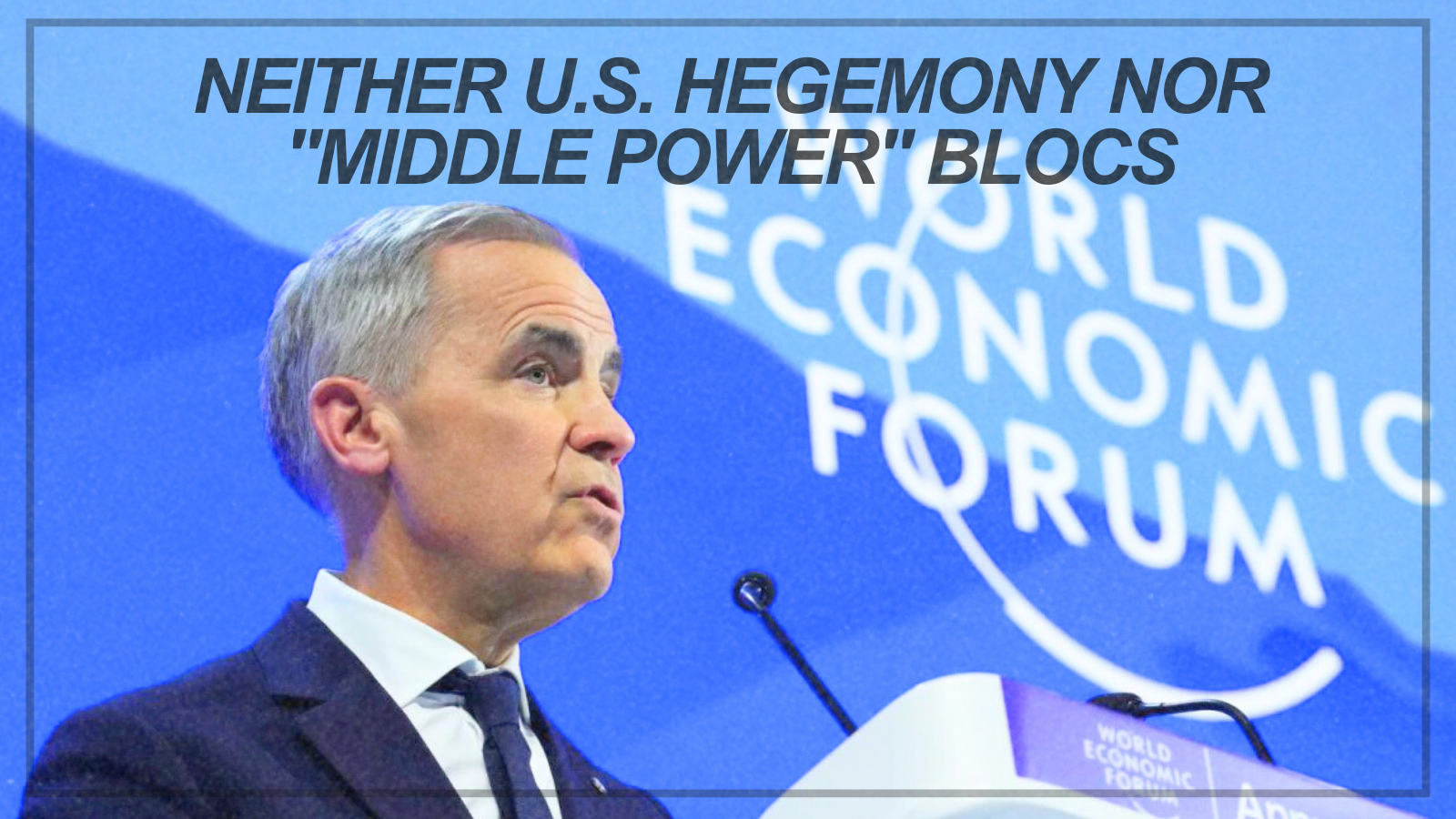
Prime Minister Mark Carney’s speech at the World Economic Forum at Davos has been noted for its blunt talk about a “rupture” with the “old order” of U.S. hegemony. This has been seen as a breath of fresh air for some in Canada who are rightly concerned with escalating threats to our sovereignty and the U.S.’s descent into war and reaction. However, Carney’s newly articulated vision does not mark a fundamental shift towards policies that will make lives better for working people, nor does it signal a Canadian foreign policy of peace and respect for the sovereignty of all countries.
Carney’s speech confirms the sharpening contradictions within the global capitalist system and the decline of U.S. imperialist hegemony. He identifies a “rupture” in the post-WWII order, correctly noting that U.S. imperialism is moving away from leadership through dominating international institutions and toward unilateral coercion, even directed against its own allies. But we must not forget who he was addressing: the main bankers and representatives of global finance capital. His message is a strategic one for their benefit.
His call for “middle powers” to act together, summed up by the line “if we’re not at the table, we’re on the menu”, is a direct response to U.S. decline. Yet this project, aimed primarily at aligning Canadian monopoly capital with European powers, leaves the majority of the world’s countries, the overexploited and underdeveloped victims of imperialism, to continue to be “on the menu.” His cited actions, like deepening EU partnerships and joining European defence procurement, are forms of intra-imperialist maneuvering, not a turn towards anti-imperialism. The only immediate strategy for peace is not found in new blocs of capitalist states but in defending the UN Charter and international law in order to fight to actually achieve the sovereign equality of states.
Carney pretends that Canada was merely silent in the past about U.S. hypocrisy and violations of international law for the sake of overall stability and growth provided by U.S. hegemony. This is false. Canada was not silent. The Canadian government was, and still is, an active participant and beneficiary of U.S.-NATO imperialist plunder. Canada’s participation in wars and regime-change projects, for example in Libya and Venezuela as well as Ukraine and beyond, are themselves violations of international law and respect for sovereignty. His government’s consideration of joining Trump’s “Board of Peace” to dismember Gaza and try to replace the UN, and his support for the U.S. abduction of Venezuela’s president reveals the hypocrisy of his “value-based realism.” Sovereignty is only to be respected within the imperialist bloc.
Overall, Carney told the financial elite that Canada will stand as a soft Western imperialist power—pragmatic, diversified, and open for business—in contrast to a more crudely aggressive U.S. imperialism. The class nature of this not-so-new strategy is evident in his domestic agenda: boasting of tax cuts for capital gains and business, dismantling internal regulations that protect workers and the public, subsidizing fossil fuels and AI, and more than tripling the military budget while financing it through the most ambitious austerity drive since the 1990s. His claim that “the world aspires” to Canadian values is hard to stomach for workers facing this austerity, for Indigenous peoples seeing their rights rolled back, and for communities enduring extreme poverty, mass unemployment, a housing and affordability crisis and collapsing health, education, and public services.
Until Canada is prepared to break with NATO there will be no fundamental “rupture” with the U.S.. Continuity can also be seen with ever-increasing U.S. ownership of natural resources in Canada and the enthusiasm in doubling down on the CUSMA. It is also unclear how much of this rhetoric from Carney and the new trade deals internationally are part of CUSMA posturing. What is very clear is that the Canadian government is talking about adjusting to a shifting imperialist order, not leaving imperialism behind.
The speech was bookended by references to anti-communist idealist theories of power and dismissed the slogan “workers of the world unite” as silly propaganda. It is, in fact, the organized power of the working-class and its allies that can build the real alternative to imperialism and usher in an international order that can secure a future of genuine sovereignty, equality, and lasting peace for all.
Central Executive Committee, Communist Party of Canada