
Labour Day 2026: Unity and mass struggle can win against against war and austerity!
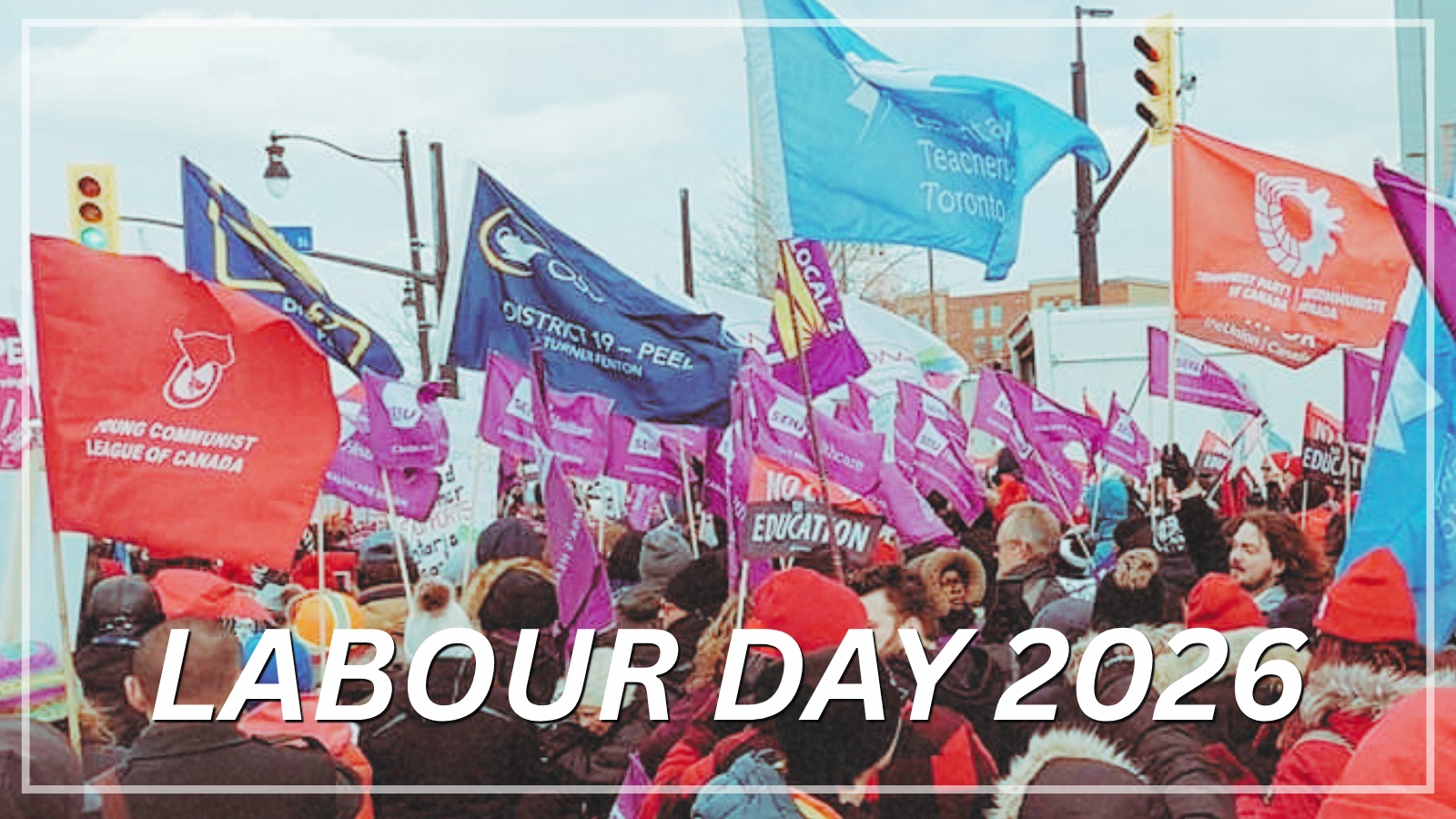
This year, working people across the country mark Labour Day against a dangerous and volatile political and economic backdrop, both domestically and globally. In this situation, workers and unions are compelled to organize, mobilize and resist – complacency is not an option.
The big picture for 2026 is the drive by imperialist powers to war, occupation, genocide and even fascism. The most open and aggressive exponent of this agenda is the United States whose support of Israel’s genocide of Palestinians, military attacks on Iran, kidnapping of Venezuela’s president and takeover of the country’s oil resources, intensification of its illegal blockade of Cuba, and neo-McCarthyist campaign that labels all political opponents as terrorists, have brought a new level of danger and violence to working people and around the world.
This picture also includes Canada’s turn to war and reaction, with Ottawa bending to Donald Trump on virtually every issue – the economy, trade, oil and resources, foreign policy and military spending.
In complete disregard for the growing social, economic and climate crises here and internationally, the Canadian government is committing $150 billion annually to a new global arms race, sharply cutting tens of thousands of public sector jobs, openly colluding with employers to curtail workers’ right to strike, trampling Indigenous rights and climate justice to build new pipelines for the tar sands monopolies, and cheerleading US violations against the sovereignty of countries around the world while capitulating to Trump’s attacks against sovereignty in Canada.
These policies – increasing aggression in foreign affairs, combined with deep austerity measures and privatization – are the response of capitalist governments to sharpening systemic contradictions which yield lower overall rates of profit, more frequent economic volatility and increased competition among the largest economic powers, as they seek to maintain and expand their spheres of influence at one another’s expense. The relative decline of US-NATO hegemony in particular is driving increased aggression by the US as well as the drive towards war and austerity here in Canada.
This scramble includes growing attacks on workers’ rights and living standards, jobs and wages, social and democratic rights, public services and social programs, Indigenous rights and peoples, immigrants and racialized people, women’s and gender equality, and on 2SLGBTQIA+ rights and people. It includes sweeping cuts to public and social services, and privatization of public services and infrastructure. It includes negotiating away a wide range of economic levers such as supply management, procurement rules and even control over mineral resources, to secure an extension of the USMCA trade deal – a continental corporate constitution that threatens hundreds of thousands of Canadian jobs and workers in auto, steel, manufacturing, forestry and farming. And it includes massive, multi-billion-dollar transfers of wealth from working people to the most powerful corporate monopolies.
These same policies are being implemented by provincial governments across the country.
Mark Carney claims to defend sovereignty and to protect working people – this is a lie. He is a central banker, one of the commanders of capitalist planning, and his policies demonstrate exactly who he represents and whose interests he protects. He is committed to defending and expanding corporate profit – at the expense of working people, at the expense of the climate, and at the expense of independent Canadian foreign and industrial policies.
Working-class resistance
With no consistent or effective opposition to this agenda within Parliament or provincial legislatures, resistance must come from working people and the labour and social movements.
In many areas, people are in motion and this resistance is building. BC nurses held the longest nursing strike in provincial history this summer, following an historic strike vote in which nearly 61,000 voted by 98.2 percent in favour of job action. Unions in Alberta continue to mobilize jointly in the Alberta Federation of Labour’s “Fight Back Now” campaign against the right-wing UCP government, which brought tens of thousands of workers out in 20 communities for a province-wide day of action at the end of May, and with another being organized for October.
In Saskatchewan, unions have joined forces with Indigenous nations, environmental groups and community organizations in a sustained campaign against a planned massive AI data centre in Regina, which leverages public infrastructure and resources for private corporate profit while jeopardizing thousands of union jobs. In Manitoba, the combined force of labour and community movements defeated a controversial Winnipeg anti-protest bylaw within days of its first draft, delivering a resounding win to people throughout the province and across Canada.
In response to the Ontario government’s campaign to privatize healthcare, the Ontario Health Coalition brought more than 1,500 people by dedicated train cars from across the province to converge in Toronto, where they joined another 6,000 healthcare workers and advocates for a mid-week protest at the provincial legislature in Toronto. The same government has been the focus for the past three months of coordinated strikes by 4,000 social and community services workers, who are calling on the province to properly fund services and workers.
Unions in Quebec have spent the year fighting an array of anti-people and anti-labour laws which undermine free bargaining by limiting the right to strike, and block all social and political action by unions. The unions brought 50,000 people into the streets at the end of last year, to protest the laws. In the lead-up to the Quebec election in October, CSN launched its Faire front (“Facing the Challenge”) campaign to press for jobs and wages, improved services, fair taxation, action on climate change and an end to privatization.
Following the Nova Scotia budget in March, people across the province took to the streets in protest against proposed arts funding cuts that would disproportionately affect African Nova Scotians, Indigenous people, people with disabilities and the elderly. Within less than a month, waves of demonstrations forced the government to partially reverse course and announce it was restoring $43 million, around one-third of the planned cuts.
For a fighting labour movement and leadership
These and many other examples point to the broad and growing basis for a united mass fight against Carney’s war and austerity politics. But that can only happen through organization and leadership. In particular, the organized working class – the labour movement – needs to step up with its tremendous resources and organizing capacity and, especially, its economic power.
That was the message from delegates to the Canadian Labour Congress convention in May, who overwhelmingly backed Palestine and Cuba solidarity and called for a coordinated fightback against austerity. While the CLC leadership failed to come through with a strong action plan, the mood from the convention floor clearly reflects working people’s willingness to fight, one that brings them into direct confrontation with Mark Carney’s pro-war, anti-people policies and with capitalist exploitation and greed in general.
This raises the question of labour leadership. Some union leaders are willing to go to the wall to protect workers facing permanent job losses. But others won’t. For every pledge to fight – such as the recent promise to occupy plants that auto companies plan to shut down, a promise made by Unifor’s Lana Payne – there seems to be another who counsels workers to not rock the boss’s boat and to “wait until we can get our friends elected in the next election.”
But even plant occupations need to go beyond negotiating better payouts for laid-off workers. The nature of the fight workers face now means we have to stop the closures entirely, to keep and increase jobs, and to nationalize operations so that they function under democratic public ownership in the interests of working people and the climate.
The fight for jobs in manufacturing and industry needs to be more strongly connected with struggles in the public sector, where many workers and their unions are already in motion. Public services, programs and institutions were never a “gift” from governments, regardless of the party in power. They were won through struggle by workers – all workers, on behalf of the entire working class and people. Now, with corporations and their governments moving to take them away for private gain, they must be defended and expanded through mass struggle by the whole of the labour and social movements, with a fighting union leadership at the core.
Among the biggest victims of Carney’s war and austerity policies are youth, whose official unemployment rate is over 12 percent – more than double that of core-age workers. Young people also experience the highest rate of precarious work – casual, contract and gig jobs – and many are burdened with enormous student debt that condemns them to hardship and poverty for decades.
Plagued by desperation and despair, young people are specifically targeted by right populist groups and ideology. This is where organized labour needs to step up, to challenge these efforts to divide and weaken the working class, by organizing the unorganized and uniting all working people – employed and unemployed, young and old – against corporate-backed attacks.
Labour Day must also be a day of working-class internationalism – the struggles of working people in Canada cannot be fully understood outside of the global picture. From Israel’s continuing genocide in Palestine to the ongoing war and humanitarian crisis in Sudan, to the NATO proxy war against Russia in Ukraine, to the US takeover of Venezuela, to the struggle of Indigenous peoples in Canada and around the world, active international solidarity is critical to building the working-class movement.
Of particular concern here are the people of Cuba, who continue to resist US imperialism despite more than six decades of economic blockade and escalating threats of invasion from the Trump administration. In the face of debilitating hardship caused by US policies, the Cuban people defend their Revolution, which is the light of liberty, sovereignty, democracy and socialism throughout the Americas and around the world.
Cuba’s struggle is about sovereignty and democracy for all peoples of the world, about international law and the UN Charter, and about peace and unity in the face of the race to war and global catastrophe. Unions and all working people need to speak up now in solidarity with Cuba, to call on the Canadian government to oppose and condemn the US blockade and threats of invasion, and to send oil and other essentials now.
The backdrop to Labour Day 2026 is a dangerous one, but it is also one marked by growing struggles. The policies of war and austerity can (and must) be defeated, but only through united mass action, with a fighting leadership, organized on a class struggle basis.
All of this highlights the necessity for socialist revolution – to build a system that organizes production for human need rather than private profit.
Unity and struggle can win!
Central Executive Committee, Communist Party of Canada