
Report on the 41st Central Convention of the Communist Party of Canada
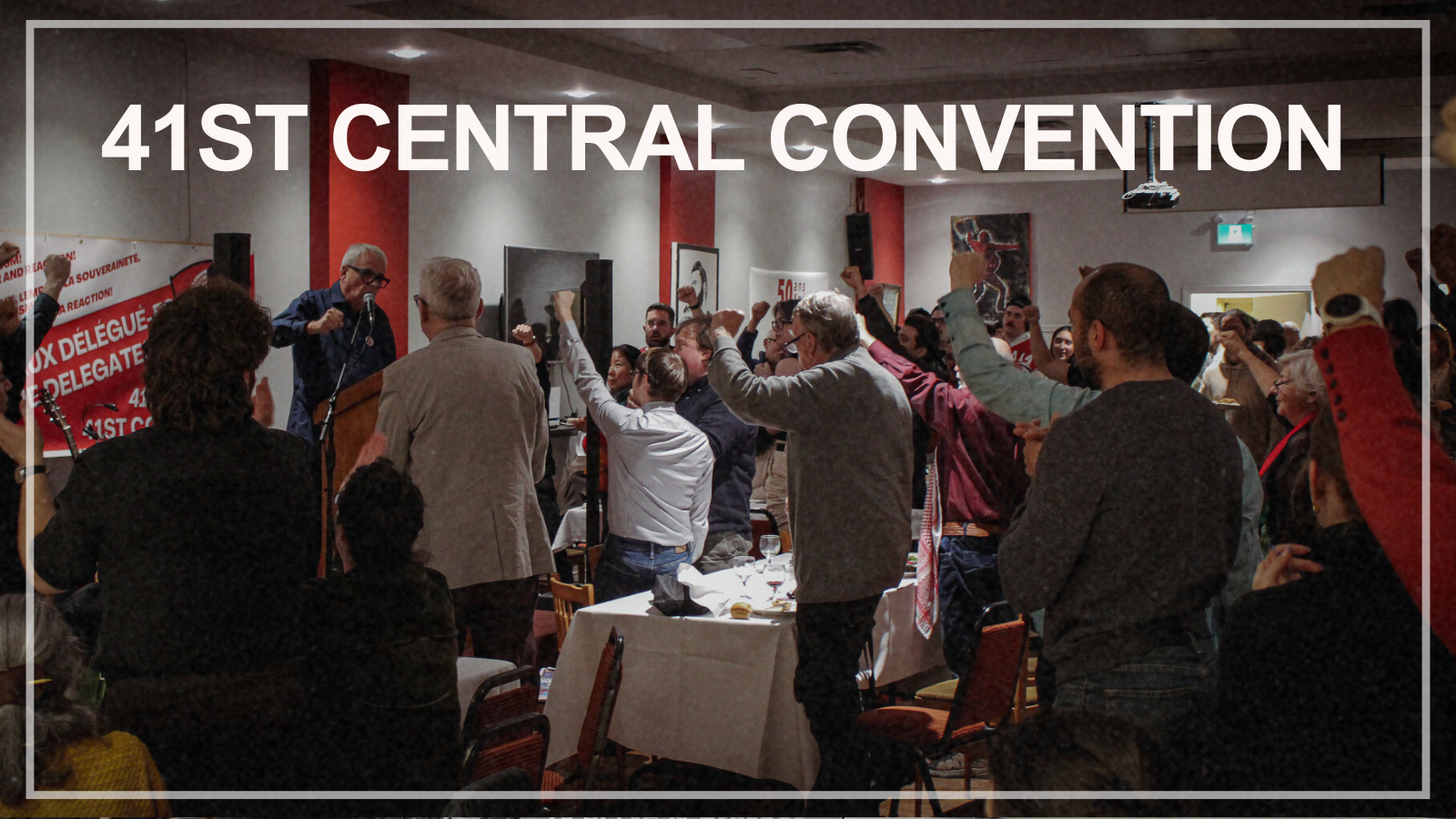
The 41st Central Convention of the Communist Party of Canada convened in Montreal from December 5-7, 2025, amidst a consequential and dangerous period for the working class in Canada and worldwide. The Convention met in a spirit of political unity, determined to analyze and respond to an accelerating imperialist drive towards world war, a rightward shift by the federal government, and a rapidly intensifying corporate assault. Delegates assessed a situation where the Carney government, using U.S. tariff pressures as a pretext, is imposing deep austerity, attacking democratic rights and massively inflating military spending, all while major strikes and popular resistance grow across the country.
Montreal was chosen to host the Convention in part because this year is the 60th anniversary of the founding of the Parti communiste du Québec (PCQ) as a distinct entity within the CPC and because of the PCQ’s recent regaining of legal status as a political party at the Quebec level. The Convention brought together delegates elected at seven Nominating Conventions held across Canada in November, alongside outgoing Central Committee members and observers, for a weekend of rich discussion and decisions.
The internationalist character of the world Communist movement was demonstrated as the Convention received written greetings from more than 35 fraternal Communist and Workers’ Parties worldwide. Direct addresses were delivered by representatives of the Sudanese Communist Party, the Communist Party of Chile, the Communist Party USA, and the Communist Party of Greece. Dany Tur de la Concepción, Deputy Head of Mission from the Cuban Embassy and Vietnamese Ambassador to Canada Pham Vinh Quang also brought greetings to the Convention, strengthening the bonds of international solidarity with socialist Cuba and Vietnam.
The Convention’s discussion on the world situation centered on a deepening systemic crisis of capitalism. Delegates analyzed a generalized crisis of imperialism marked by declining U.S. hegemony, economic instability, and the sharpening of all inherent capitalist contradictions. The erosion of the unipolar order and the rise of a more multipolar world was seen as challenging U.S. dominance, but also creating new imperialist rivalries and dangers, rather than representing an inherently anti-imperialist development. Most urgently, the Convention identified an accelerated drive to militarism and war, led by the U.S., pushing the world toward a permanent war economy and risking nuclear confrontation. This aggression is manifested in the genocide in Gaza, the proxy war in Ukraine, and comprehensive economic warfare, with U.S. imperialism designating China as its primary enemy. The Convention discussed the ongoing war crimes and genocide taking place in Palestine and Sudan and the complicity of the Canadian government in both cases. This can be seen clearly in the continued flow of Canadian arms to Israel and Sudan.
From this analysis, the Convention mandated a reinforced focus on peace activism. Key tasks include strengthening the Canadian Peace Congress and the Mouvement Québécois pour la paix (MQP), fighting the ramping up of Canada’s war economy, and prioritizing and reinforcing our solidarity work with Cuba and Palestine. The Plan of Work also includes strengthening joint work with sister Communist Parties that have organizations in Canada, especially the Sudanese Communist Party who urgently need solidarity in their fight for peace.
The Convention examined a Canadian political situation where the capitalist crisis is fueling the growth of far-right and neo-fascist movements, alongside reactionary government policies that erode democratic rights. While the Trump administration threatens to make Canada the 51st state and all bourgeois politicians rally around Canadian nationalism, the Canadian economy is in fact becoming further subordinated to U.S. imperialism. The new government is using the tariff war to deepen corporate power, impose austerity, slash social programs, and boost military spending, as evidenced in the recent federal budget. Against this austerity offensive, the working class is engaged in a sharpening struggle, with militant strikes becoming more frequent.
The CPC advocates a People’s Alternative: an anti-monopoly and anti-imperialist program featuring nationalization of key sectors, a full-employment economy, social housing, multilateral, mutually beneficial trade policy, withdrawal from CUSMA, NATO and NORAD, and a foreign policy of peace and disarmament. To advance the fightback, the Convention resolved to continue helping to organize left caucuses with a class-struggle orientation within the labour movement to win the centre to the left for unity in action, and to update the Party’s labour program. Building a cross-Canada fightback against austerity, centered on the upcoming Canadian Labour Congress convention, was deemed critical. Recognizing that austerity and reactionary movements disproportionately target women and gender-oppressed people, the Convention also committed to reinforcing the struggle for gender equality by organizing a cross-Canada meeting, publishing a specific program for women and gender-oppressed people, and building on International Women’s Day actions.
A core premise of the Convention was that navigating this period of crisis requires a larger, more disciplined, and ideologically strengthened Communist Party. The ultimate solution to the crises of capitalism, war, and environmental collapse remains the revolutionary transformation to socialism, guided by the scientific application of Marxism-Leninism. To build the Party’s capacity, the Convention prioritized developing educational materials for clubs, organizing new members’ and cadre schools, and building the theoretical journal, The Spark!.
A major focus was reinforcing the Party press, People’s Voice and Clarté, as the collective educator, agitator, and organizer. Plans include ensuring subscriptions for all members and friends, establishing club-level distribution and discussion plans, running an annual subscription drive, and increasing the frequency of online updates while building the email list. The Convention also stressed building on successful party-wide campaigns with better organizational support, including regular check-ins and debriefs. The vital work of the Young Communist League (YCL-LJC) was highlighted, with a resolve to deepen Party-League collaboration and ensure an organized approach to recruiting from the YCL-LJC and directing young applicants first to the YCL-LJC.
The pre-Convention discussion in clubs was reflected in amendments submitted from across the country to the draft Political Resolution. Adopted amendments strengthened the Resolution’s analysis on several fronts: the need for public ownership and democratic control of Artificial Intelligence; the necessity of building an anti-monopoly, anti-imperialist alliance as the genuine barrier to fascism at this juncture, as opposed to supporting bourgeois forces; the use of the tariff war to attack Indigenous rights, environmental protections, and civil liberties (e.g., Bills C-2, C-8); the imperative to combat anti-immigrant racism; new attacks on union political rights in Quebec (Bill 3); the need for labour unity ahead of CUSMA renegotiations; deepening the analysis of and fight against transphobia and the scapegoating of gender-diverse people; and expanding on Israel’s crimes in Palestine and the strengthened position of US imperialism in West Asia. Several amendments were referred to the incoming Central Committee for further discussion, with the final Political Resolution to be published in early 2026.
In addition to the main Political Resolution, the Convention passed several important special resolutions affirming the Party’s stance on critical struggles. Delegates solemnly commemorated the December 6th, 1989, Montreal massacre at École Polytechnique, a misogynist attack that took the lives of 14 women, and reaffirmed the Party’s commitment to the fight to end gender-based violence and for full equality for women and gender-diverse people. A special resolution on the deadly opioid crisis was agreed to by the Convention. Resolutions of militant solidarity were adopted with: the Sudanese Communist Party and the people of Sudan in their struggle for peace and democracy against war crimes committed by rival military factions backed by competing imperialist interests; the people of Cuba, demanding an immediate end to the criminal U.S. blockade; the working class and people of Colombia in their upcoming 2026 Presidential elections and in the ongoing struggle for peace, social progress, and the freedom of all political prisoners; and the people of Venezuela against the escalating drive to war and regime change by the Trump administration, demanding an end to Canada’s complicity in these destabilization efforts. The Convention condemned the recent banning of the Communist Party of Poland as part of a broader anti-Communist campaign worldwide. These and other resolutions passed at the Convention will be circulated to the membership and the public in the coming days.
The Convention elected a new Central Committee on the last day, successfully balancing renewal and continuity. The new Central Committee reflecs the renewal of cadre at club and provincial levels. The Central Executive Committee (CEC), elected by the new CC, also shows this balance. It includes new BC Party leader Rob Crooks, People’s Voice Editor Dave McKee, Spark! Editor Jeanne McGuire, YCL General Secretary Ivan Byard, and PCQ National Secretary Adrien Welsh.
The new CEC also includes Drew Garvie, elected Party leader by the Central Committee, and Elizabeth Rowley, who stepped down as leader at this Convention.
The incoming leader, Drew Garvie, brings experience from working for the Party in various assignments for the last ten years. Politicized during the fights against the Harris Conservatives in Ontario and the 2003 Iraq War, he became active in the student movement in Guelph. He joined the Young Communist League in 2004 and was elected its General Secretary in 2014. He served as the CPC’s Central Organizer in 2017 and, since 2019, as Ontario Provincial Secretary.
The Convention thanked Elizabeth Rowley celebrating her 50 years of working for the Party and 10 years as leader. She will continue her contributions on the Central Committee and Central Executive.
Longtime CEC members Kimball Cariou, former BC Party leader and long-time People’s Voice editor, and Miguel Figueroa, Party leader from 1992-2015, were re-elected to the Central Committee but stepped down from the CEC. The Convention thanked them for their decades of dedicated service to that leading body.
The Saturday night Convention banquet was a resounding success, with over 150 members and friends in attendance. The program featured speeches from international guests, labour-themed and Communist live music, a keynote from Elizabeth Rowley, and tributes to her contributions. The Convention extended profound thanks to the Parti communiste du Québec for its excellent work in hosting a smooth and successful event.
The newly elected Central Committee will hold its first full meeting early in the new year to establish commissions and begin implementing the Plan of Work adopted by the 41st Convention. The delegates departed Montreal resolved that in this era of war, reaction, and sharpening class conflict, the task of building a powerful Communist Party and advancing the struggle for a socialist, peaceful future is more urgent than ever. The Convention affirmed that the path forward lies in organized, militant struggle, offering a clear socialist alternative to the barbarism of capitalism in crisis.
Central Executive Committee, Communist Party of Canada